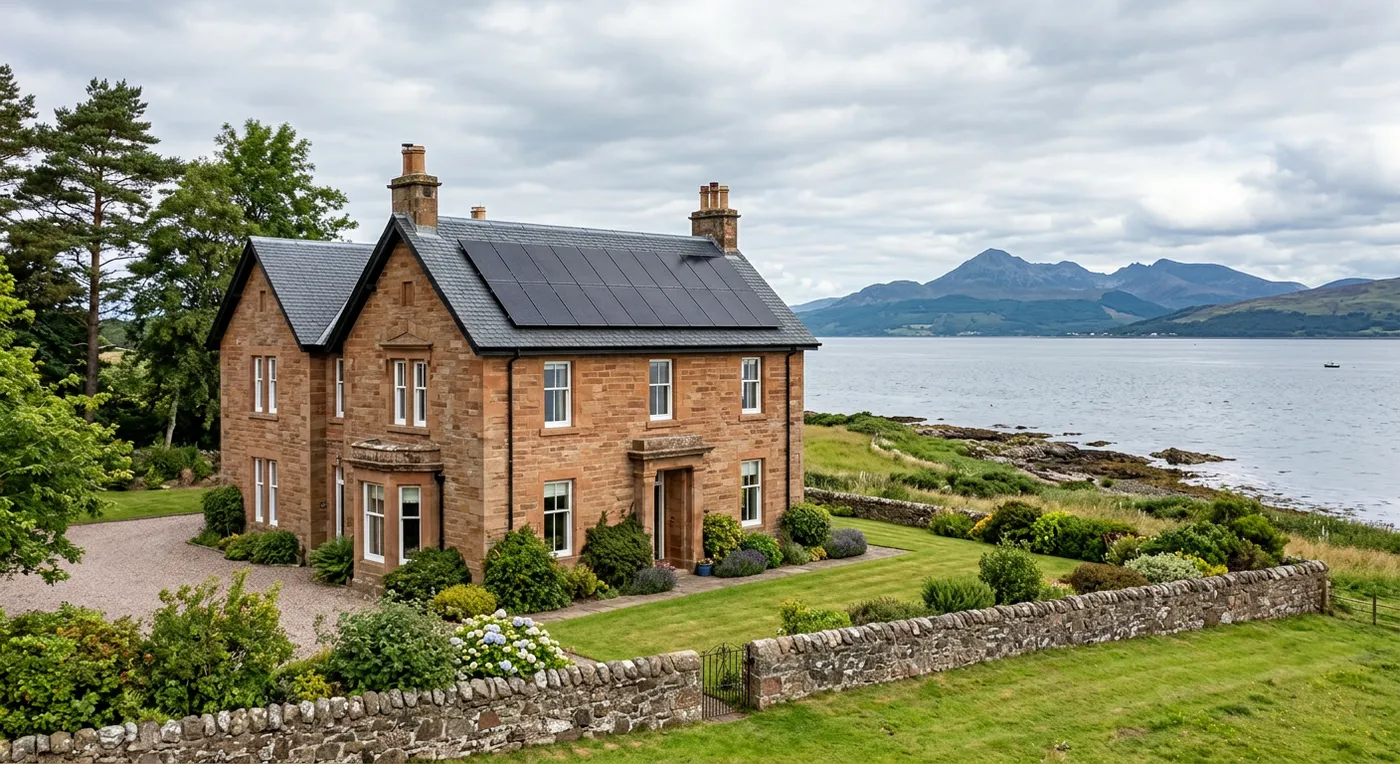
Do solar panels work in Scottish weather?
Yes. Solar panels generate electricity from daylight, not just direct sunshine, so they still produce on cloudy days — just less than in bright sun. Scotland has longer summer daylight hours than southern England, which helps offset shorter winter days. Cool temperatures also improve panel efficiency.
A common misconception is that solar panels need blue skies. In fact, panels convert light (photons) into electricity, and daylight is present even under thick cloud. A cloudy day in Ayrshire still produces a meaningful amount of electricity — typically 10 to 25 per cent of a sunny day's output.
Scotland's long summer days are a real advantage. In June and July, Ayrshire gets around 17 hours of daylight, meaning panels generate for far longer each day than in southern England. This helps balance out the shorter winter days when output is lower.
Cool panel temperatures actually improve efficiency. Solar panels lose output when they get too hot, so the mild Scottish climate is not the disadvantage people often assume. Spring and early summer in Scotland can be very productive.
How much electricity do solar panels produce in Scotland?
PVGIS modelling for Ayrshire gives roughly 920 kWh per kWp per year on a well-placed roof. A typical 4 kWp system would generate around 3,680 kWh per year. Your survey models the exact figure for your roof, including orientation, pitch and shading.
The figure of 920 kWh per kWp is based on PVGIS data for the Ayrshire coordinates (55.46 degrees north). This is lower than southern England (around 1,000 to 1,100 kWh per kWp) but still comfortably enough to make solar worthwhile for most homes.
A south-facing roof at 30 to 40 degrees pitch gives the highest annual output. East and west-facing roofs produce about 80 per cent of a south roof, but spread generation more evenly across the day, which can suit households who use electricity in the morning and evening.
Shading from trees, chimneys or neighbouring buildings reduces output. Your survey checks this and models the real figure for your roof, not a theoretical maximum.
What makes solar worth it for a Scottish home?
Solar is most worth it when you use a good share of your electricity during the day, when panels are generating. Households who work from home, are retired, or run appliances in daylight hours get the best value. A battery extends the benefit to evening use. Your written quote confirms the expected output.
The economics of solar depend on how much of your own generation you use (self-consumption) versus how much you export. Using your own solar power is worth more than exporting it, because export rates under the Smart Export Guarantee are usually lower than what you pay for electricity.
Households who are home during the day — retired people, home workers, or families with young children — tend to use more of their solar directly. A battery helps everyone else by storing surplus daytime generation for the evening.
An electric car or heat pump increases self-consumption further, because charging or heating can be timed to coincide with solar generation. This is one of the strongest cases for solar in Scotland.
What about winter in Scotland?
Output is lowest in December and January — typically 3 to 8 per cent of annual generation comes from these two months. But solar panels produce for 10 months of the year in useful quantities. A battery and a time-of-use tariff can help bridge the winter gap by charging on cheap overnight electricity.
No solar system covers all of a home's needs in a Scottish winter. The value comes from the 8 to 10 months where generation is meaningful, especially April to September when output is highest.
Some households charge their battery from the grid on a cheap overnight tariff (such as Octopus Agile or similar) during winter, then use that stored electricity during the day. This is separate from solar but works well alongside it. We talk through whether this suits you at survey.
How do I tell if solar is worth it for my home?
Book a no-obligation survey. We look at your roof direction, pitch, shading, fuse board and electricity use, then model the expected output for your own roof. You receive a written quote showing system size, equipment and price. You decide in your own time with real numbers, not estimates.
The survey is free and there is no pressure to go ahead. We tell you honestly if solar is not a good fit for your home — for example, if heavy shading means output would be too low to justify the cost.
Have a recent electricity bill to hand if you can. It helps us size the system to how you actually use power, rather than fitting as many panels as the roof allows.