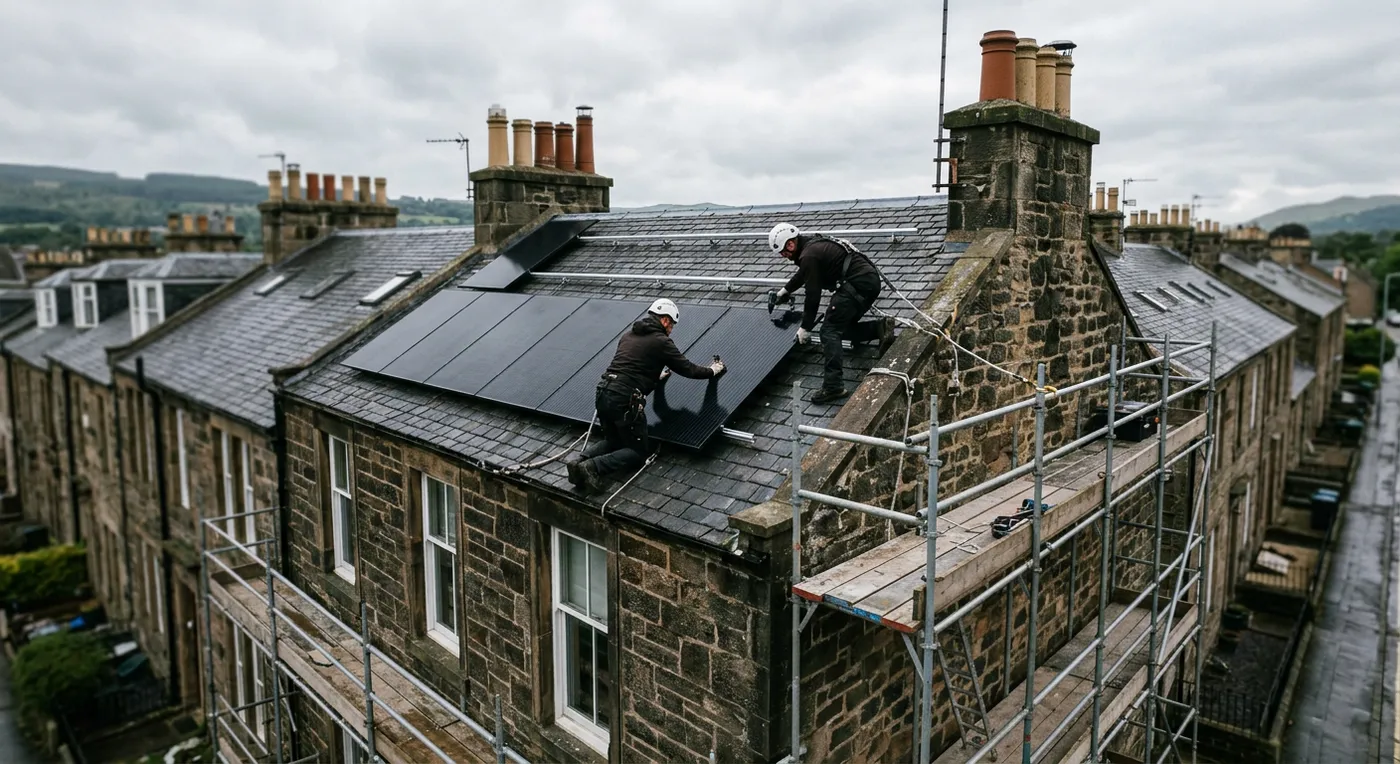
Do solar panels work well in Kilmarnock?
Yes. Solar panels generate from daylight, not just bright sunshine, so they work through Scottish weather. PVGIS modelling for Ayrshire gives roughly 920 kWh per kWp each year on a well-placed roof. Your survey models the output for your own Kilmarnock roof, including any shading from trees or buildings.
Kilmarnock sits a little further inland than Ayr and Troon, but the difference in yearly output is small. Roof direction, pitch and shading matter far more than which side of Ayrshire you live on.
Cool temperatures actually help: solar panels run more efficiently when they are not overheating, which is one reason they perform well in Scotland in spring and early summer.
Which areas around Kilmarnock do you cover?
We cover all of East Ayrshire, including Kilmarnock, Kilmaurs, Hurlford, Crosshouse, Stewarton, Galston, Newmilns, Darvel, Mauchline, Catrine, Cumnock and Dalmellington. Every KA postcode in the area is included, and rural farms and steadings are just as welcome as town houses.
If you are unsure whether your address is covered, call 0141 230 0198 and we will confirm straight away.
For a dedicated resource on local solar installers covering Kilmarnock, see our sister site at solarpanelskilmarnock.co.uk. Part of the Scottish Energy Efficiency network.
Do I need planning permission for solar panels in East Ayrshire?
Most roof-mounted solar panels on houses in Scotland count as permitted development, so planning permission is usually not needed. Listed buildings, homes in conservation areas, flats and ground-mounted arrays can be different. Your survey checks this, and East Ayrshire Council can confirm the position for your property.
Parts of older town centres and villages sit within conservation areas, where panels on a roof facing the street may need consent. Panels on a rear roof slope are often treated differently. We will flag anything that needs checking before work is booked.
What types of homes in Kilmarnock suit solar?
Most homes with a reasonably unshaded roof suit solar. South-facing roofs give the most output, but east and west roofs still work well and spread generation across the day. Semi-detached homes, bungalows, newer estates and detached villas are all common installs across Kilmarnock and East Ayrshire.
Farmhouses and steadings often have large outbuilding roofs, which can make good sites for bigger systems. Ground-mounted panels are another option on rural land, subject to planning.
How does connecting solar to the grid work in Kilmarnock?
SP Energy Networks runs the local electricity network. Smaller systems are usually notified under G98 after installation, while larger systems need G99 approval before work starts. Our installation partners handle this paperwork as standard, so you do not need to contact the network operator yourself.
If your system needs G99 approval, the network operator’s response time can affect your installation date. We will tell you at survey if this applies.