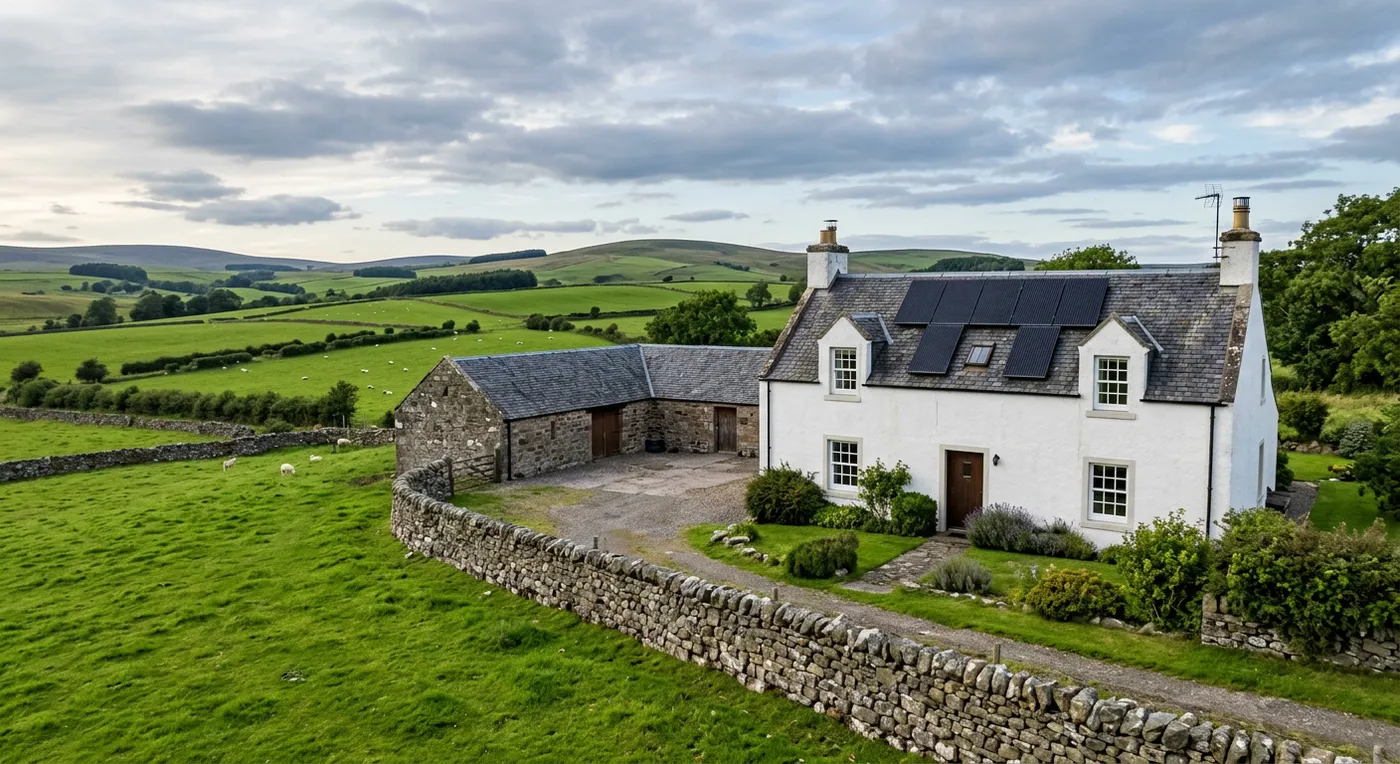
Why do farms and rural properties suit solar?
Farms and rural properties typically have large, unshaded roof areas on barns, sheds and outbuildings, which can host bigger solar systems than a house roof. Many rural homes are off the mains gas grid and heat with oil or LPG, making any reduction in electricity bills more valuable. Open land also allows ground-mounted arrays.
A typical house roof might fit 12 to 16 panels (3 to 4 kWp). A large barn roof can easily accommodate 30 to 50 panels (8 to 13 kWp) or more, generating enough to run milking equipment, lighting, refrigeration, workshops and machinery.
For off-gas homes, pairing solar with a heat pump can replace oil or LPG heating with electricity that is partly covered by your own generation. This combination is increasingly popular in rural East Ayrshire and the Doon Valley.
Rural properties often have three-phase electricity connections, which can allow larger systems without needing a G99 application — though this depends on the local network capacity and is checked at survey.
Can I put solar panels on a barn roof?
Yes. Barn roofs are ideal for solar because they are usually large, unshaded and have simple roof slopes. Corrugated metal, box profile and fibre cement roofs all take panels with appropriate mounting systems. Your survey checks the roof structure to confirm it can carry the additional load.
Mounting systems for metal roofs use clamps that attach to the profile without penetrating the sheet, keeping the roof weatherproof. For fibre cement roofs, specially designed brackets are used. The installer checks the roof structure at survey.
If your barn has a fragile or ageing roof, it may be worth re-roofing before installing solar. We can advise on this at survey and factor it into the quote.
Can I have ground-mounted solar panels on my land?
Yes, ground-mounted solar arrays are an option on agricultural land where roof space is limited or not suitable. They typically need planning permission from the local council, and we can help prepare the application details. Ground-mounted systems can be sized to match your electricity use and land availability.
Ground-mounted arrays are mounted on frames fixed to the ground, usually angled south at 30 to 40 degrees. They can be placed in fields, paddocks or unused corners of the property.
Planning permission is generally required for ground-mounted solar in Scotland, unlike roof-mounted systems on houses which are usually permitted development. The application needs details of panel positions, heights, screening and access. We help with this.
For larger ground-mounted systems (typically over 50 kW), a G99 application to SP Energy Networks is also needed before installation. Our installer partners handle this paperwork.
Should I add battery storage to a farm solar system?
Often yes. Farms and rural businesses frequently use electricity early in the morning and in the evening (milking, feeding, lighting), which does not always match peak solar generation. A battery stores surplus daytime electricity for these periods, increasing self-consumption and reducing grid imports.
For dairy farms, a battery can store solar power generated at midday for the evening milking shift. For workshops, it can power tools and machinery into the evening. The right battery size depends on your usage pattern, which we review at survey.
A battery can also provide backup power during outages if the right equipment is specified. Rural properties are more prone to power cuts, so this is worth discussing at survey.
Can I pair solar with a heat pump on a rural property?
Yes, and for off-gas homes this can be one of the best investments you make. A heat pump replaces oil or LPG heating with electricity, and solar panels offset some of that electricity. A battery stores solar power for when the heat pump runs in the evening. 0% VAT applies to both solar panels and heat pumps until 31 March 2027.
The heat pump needs to be correctly sized for your property, and the solar system sized to your total electricity use including heating. Your survey covers both. This is a significant investment but can dramatically reduce running costs for off-gas homes.
Even without a heat pump, solar alone reduces electricity bills for rural homes. And if you add a heat pump later, a battery-ready solar system means the upgrade is straightforward.